With Halloween just around the corner, it is almost impossible to ignore the advertisements for costumes from Party City, Walmart, and other outlets. Even more high-end stores like Burlington get in on the action. The costume industry big business for children and adults alike but one thing I notice every year is the very big difference between male costumes and women's costumes.
It is practically impossible to go shopping either online or in store and not see some sexy version of a Halloween costume, and it is slightly ridiculous. Even ignoring people who are dressing up as a specific character from the specific television show that they may enjoy, there are also such sexafied costumes as sexy flight attendant, sexy vampire, sexy nurse, sexy schoolgirl, sexy candy bar, and my personal favorite sexy Chinese takeout box.
I guess that my real problem with the sexy Halloween costume is that 99% of the costumes that I see online are geared towards women. Well I may sometimes see a sexy version for a Male costume most of the time they aren't on the website or in stores, and even if they are on the website I very rarely if ever see a man actually dressed ‘Sexy’ on Halloween. Additionally, sexy male costumes can be presented in different ways. Take the below picture. I know what the hose represents and so do you. But compared to sexy female firefighter, it’s barely anything to protest about.
I don't have any problem with the people who want to be sexy on Halloween, you do you. But when my only options are to either bare more than I personally feel comfortable with or piece together my own costume, there is an issue. This year, I’m handing out candy as a poodle girl. The costume is my mom's from when she was my age, and it is the third time I will borrow it. Whatever your plans are, when you're looking for your costume pay attention to the other gender and have a happy Halloween.
When people think about reality television, one of the first shows mentioned is almost always Survivor. Running on CBS since 2000, the show is cure toy airing it's 35th season and shows no sign of slowing down. It should be no surprise that a long running show like survivor would have controversies associated with it, but long standing fans of the show were shocked last season when Jeff Varner outed Zeke Smith as transgender during tribal council.
For anybody who is never seen survivor before, wasn't watching that season, or has since forgotten that infamous tribal Council, let me give a quick recap. Jeff Varner is a man who has played Survivor twice before. He is from North Carolina, in his 50’s, and is openly gay. Zeke Smith on the other hand is 28 years old, is currently playing back-to-back seasons of Survivor, and is not “Out”. Varner, aware that he is on the bottom it the Tribe and will probably be voted out that night declares to the audience that he knows something about Zeke that no one else does. That he (Smith) is not the guy we think he is, and that he (Varner) is not going down without a fight.
At tribal council, Varner begins to make a speech about deception within the tribe, before turning to Zeke and asking him “Why haven't you told anyone you are transgender?” This is a negative stereotype in the representation of transgendered individuals. It is often associated with a fear that an individual may pretend to be transgender in order to spy on people of the opposite sex. What is extremely important is that after the outing, there was an immensely positive response for Zeke by his tribe mates, host Jeff Probst, the producers and by news outlets across the country and the world.
Starting with his tribe mates, the members of Nuku immediately confronted Varner, stating that the outing was unnecessary. Contestant Debbie Wanner proclaimed that Zeke’s gender identity was personal and had nothing to do with the game. Varner tried to backtrack and apologized multiple time over the coursed of the night, but his words could not be unspoken and at the end of tribal council, Nuku unanimously voted out Varner.
In a later interview with Entertainment Weekly, Varner stated that he believed that Zeke was already out. Because filming for survivor game changers took place while Survivor: Millennials vs. Gen X aired, he had no idea what Zeke’s narrative for the season had been. Varner states his assumption that Zeke had been “touted” as the first transgendered survivor player and his gender identity was only a secret from his current tribe mate. As millions of people saw this was a very dangerous, and ultimately incorrect, assumption to make.
Following the episode being aired, fans took to social media in storm. Many people were casting the blame on to Varner, but some were also blaming CBS.
They claimed that while Varner was the person who outed Zeke to the tribe, it was the Survivor producers and CBS who outed him to everyone watching at home. Honestly, I am not sure how I feel about that issue. Of course Varner must have responsibility for what he said, but should CBS have removed the incident from their broadcast? For me, it comes down to Zeke. In a lengthy interview with The Hollywood Reporter, Zeke said it had never crossed his mind that it shouldn't air. He also stated that he had been given unprecedented control over how the episode would be handed. Whether or not CBS should have edited out that part of tribal council should be weighed with the fact that Zeke never asked them to.
I’ll be honest with you. I have never seen or read Harry Potter and the Cursed Child, and despite my love for the series I have no interest in going to see it. I live in neither London nor New York and seeing a show on Broadway for me is expensive enough when going to a one part show. A two part show seem excessive, but there is one thing that I want to talk about with the show and that is Black Hermione.
I was 6 years old when Harry Potter and the Sorcerer's Stone came out in the United States, and I was immediately in love with the series. My mom took me into my younger brothers room and the plan was to read about half a chapter each night before going to bed. The problem was that I loved to read so that by the time mom and my brother were on chapter 3, I had finished the book and was waiting with bated breath for the next one. To be honest, most parents wouldn’t consider that a problem. For my parents? They were dealing with two extremes. A daughter who would much rather climb to the top of the jungle gym and sit there for all of recess in order to read without being bothered, and a son who would have happily paid me to summarize his book report books for him if mom didn’t have eyes in the back of her head. Before the movies came out, my idea of Hermione was a girl like me. A young girl who is a bit awkward around people, a few reading levels above her peers, learns more by looking ahead in the text book for interesting things, and looks for supplementary materials to learn more outside of class. She was a kid like me, so like any child I pictured her as me. When the movies started came out three years later I still had that image of Hermione being like me, only now I had an face to put to my ideas. Emma Watson looked well enough like me. Brown hair unkempt from too little time brushing it, brown eyes with a thirst for knowledge, and pale skin from sitting in the library a bit to long. I was happy and didn’t really think much more about it. I had an ‘official’ version of Hermione and even as Emma Watson grew up and stopped looking like me as much, I didn’t worry about it. I grew up, but never grew out of Harry Potter. Technology grew, I got a computer and eventually I joined social media. I made online friends, read fanfiction, and followed some blogs. By the time Harry Potter and the Cursed Child was announced, I had seensomefanart of poc Harry Potter characters. I even saw a few fanmade recasts for the actors. However, I never saw any large scale backlash to the idea until the announcement came out that Hermione would be Black in the stage play. Suddenly, now that a Black Hermione had the potential to be “canon” so many people were coming out of the woodwork to reprimand the idea.
One of the biggest criticisms for a black Hermione was that Emma Watson is white, so Hermione has to be, but the movies didn’t come first. The books did. Nowhere in the books does it say what race Hermione is. I saw Hermione as white before the movies came out growing up because I saw her as like me. There is nothing wrong with that. If some other little girl who started to read those books with her mom and little brother and saw herself in Hermione like I did, but wasn’t white? That is also okay, and nothing changes that. Not the movies, the fanfiction, the promos, fanart, recastings, or the play. I saw me as Hermione. If you see your ‘me’ then that is what matters and never let anyone tell you otherwise.
Imagine that you are 12 years old. You’ve just run home from the bus stop, dashed past your parents waiting for a hello, and leapt into the couch while making a grab for the remote. You tune out the scolding from your parents about politeness and jumping on the furniture and punch in the numbers for Nickelodeon and are just in time for your favorite afternoon special.
Ignoring the fact that kids today have the ability to record their favorite programs, this is an image probably familiar to many of you from your own childhoods. Maybe you preferred Cartoon Network over Nick, or you were an avid devotee of Saturday morning cartoons but the image is none the less familiar. Another familiar image probably is the advertisements that came along with your favorite shows. Ads for the latest toys, books, clothes and other television shows penetrate the breaks in whatever you are watching to sell you, or rather convince you to make your parents buy you the next great thing.
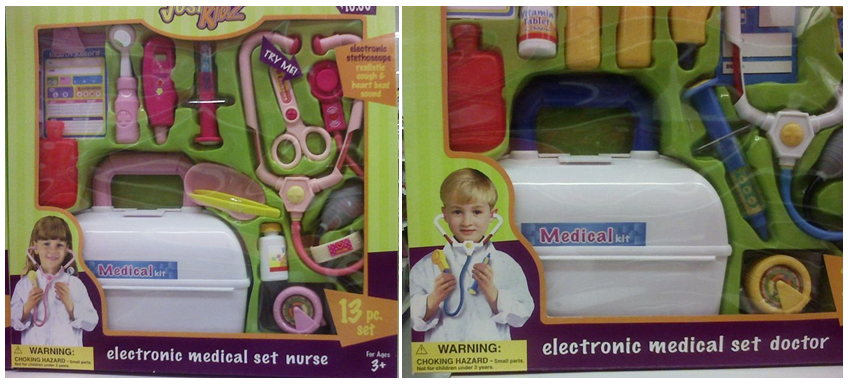
Gendered advertising has been around for awhile now. Companies use gender in order to sell the same product twice, once to men and then again to women. Multiplying sales mean that they get more money, but what does this mean for children’s advertising? Kids are often smarter than we realize, but are they able to recognize that they are being manipulated into gender roles that may leave a lasting impression on their psyche by advertisers for the sole purpose of companies selling more toys? Or if they are able to recognize it, can those same children resist the boundaries put up by advertisers for their entire childhood into adolescence and adult life?
The answer to that is complicated. Every child is different, they are raised by different parents, and are given differing values by relatives, teachers, and members of their communities. While some children have been raised to recognize and actively resist gender stereotypes in advertising, others my ave parents who either don’t recognize this as an issue, don’t care, or may recognize the problem, but lack the time to talk about it.
Things are getting better. Recently in the UK, regulatory acts were passed that banned the use of gendered stereotypes in advertising due to fears that it could influence children negatively as they grow up. While these regulations only apply to the United Kingdom, in an increasingly global society it is easy, if perhaps a bit optimistic, to imaging these regulations causing a a domino affect within the advertising industry.
The One to Wear: An Analysis of “Say Yes to the Dress”
It is the day that every woman dreams about for their entire life. A bouquet of flowers in her hands, walking down the aisle to an eternal bliss. Everything has to be right. An amazing venue with good food, your family and friends and to top it all off, that perfect once in a lifetime dress. Or so television would like us to believe.
Say Yes to the Dress is a reality show that appeared in October of 2007 on TLC that revolves around finding the perfect dress for your perfect day. Future brides deal with budget concerns, personal struggles and overwhelming guests, in their search for their ‘ the one’. Fifteen seasons on with multiple spinoffs and international versions, it is clear that audiences love watching women get ready for their wedding day, but why?
Part of the reason is that there is always someone on the show who is ‘real’. With a rotating cast of future brides and their entourages backed by the steadfast presence of consultants there is always someone that we are sympathetic towards. Some nights it is the consultants as bridezillas make the appointment impossible before leaving in a huff. In other cases we feel for the bride whose family and friends just don’t seem to grasp that this is her day and not theirs.
Additionally the show presents the idea of conspicuous consumerism. Many of the brides featured on the show either want more then one dress, normally one traditional for the ceremony and another that is shorter and “more fun” for the reception, or they try on dresses that go above their stated price points and then they just can’t go back to the lesser dress. Whether with one budget breaking dress, or with more than one, Say Yes to the Dress presents the idea your perfect day can only be made better if you spend enough money.
From ballgowns to minidresses, Say Yes to the Dress has every kind of dress for every type of bride. Some we love, some we hate and some we just want to say Why. Between beautiful dresses, emotional conflicts and promise of a happy ending for the future bride, it is no wonder that audiences are always drawn back into the Salon to watch another dream come true.
It has been a few weeks since the 20th anniversary of the death of Princess Diana and as the world remembers the legacy of her life in numerous documentaries, I feel it is also important to acknowledge the changes that came to British media following her death.
In the years preceding her fatal car crash, Diana had been called “the most hunted person of the modern age”. Everyone loved her and it is easy to see why. Diana was not only a beautiful woman, but she was well known for her charity work around the globe. She was also easy for the people of the United Kingdom and around the world to relate to, especially when compared to her late husband. Diana’s Panorama interview in 1995 gained her tremendous sympathy from the press and the public, but also meant that any news stories about her were a great commodity.
Paparazzi photographers Mark Saunders and Glenn Harvey recalled a chase from 1994 in their book Dicing With Di: The Amazing Adventures of Britain’s Royal Chasers where Harvey dove across the front of Diana's Audi for the perfect shot just before their prey reached the safety of Kensington Palace. For the photographers it was business as usual while chasing the Princess. For Diana it was a living nightmare.
Following her death in Paris, the Paparazzi who chased her through that dark tunnel and the media outlets who bought their photos were vilified by the public at large. Among those who blamed the media for her death were Diana’s brother and her sons. At the time Earl Charles Spencer, Diana’s brother was quoted as to saying "I always believed that the press would kill her in the end". Additionally, Prince Harry recalls in a recent documentary titled Diana, 7 days that one of the hardest things for him to deal with was that the paparazzi who had chased her down in those final moments were to busy taking pictures of her dying in the back of the car to actually help her.
In an effort to prevent an extremely restrictive privacy law being put into place by the British Government, Newspaper editors on Fleet Street took a voluntary step back and declared that they would no longer purchase photographs from the types of photographers who had pursued Diana that night, would extend the rights of privacy to public spaces where a “reasonable expectation of privacy” and gave a much larger protections to young people. The last point was especially important in consideration for the young princes who were 15 and 12 at the time.
Twenty years on and those protections still remain largely in place within Britain. Prince William and his family can become annoyed at the press, but they do not live in fear of it as William’s mother sometimes did. So while undoubtedly as this anniversary passes on, people will remember Diana for her charitable work and for the children that she raised, it is important to recognize that even in the tragedy of her death, the People’s Princess still invoked change with the way the press would act around those she loved most.